


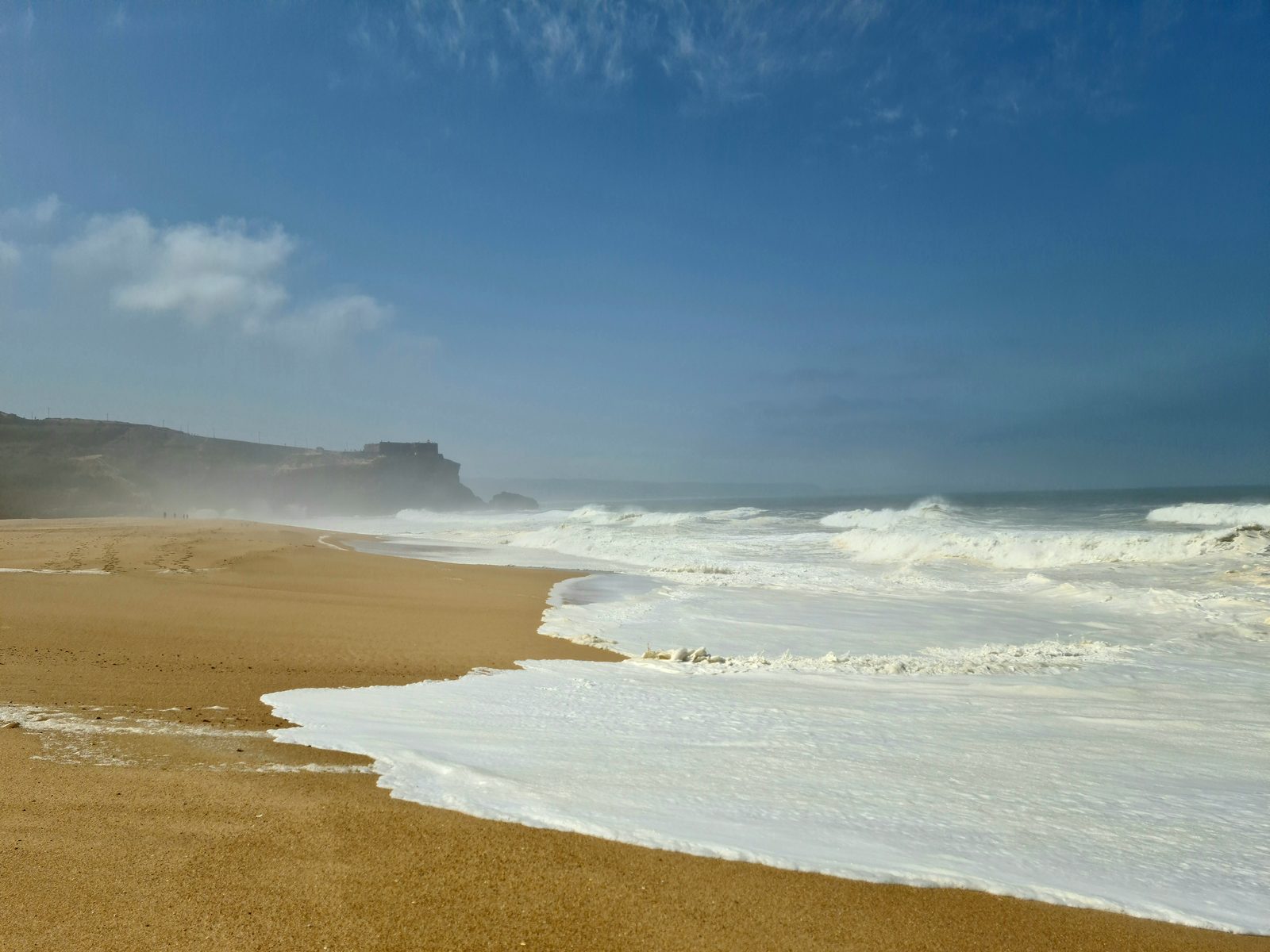
Praia do Norte: where the biggest waves break
Praia do Norte sits on the north side of Nazaré, directly below the clifftop neighbourhood of Sítio and the Forte de São Miguel Arcanjo. It's the beach that gave Nazaré its global reputation — home to some of the largest waves ever surfed, recognised by the Guinness World Records, and host to the TUDOR Nazaré Tow Surfing Challenge on the World Surf League's Big Wave Tour.
It is not a conventional surf beach. Praia do Norte exists, in its current form, specifically for giant, canyon-amplified swell — a spectator destination and a professional big-wave arena, not a place for recreational surfing or swimming during the winter season.
The Nazaré Canyon: the amplifier offshore
The reason Praia do Norte breaks so much bigger than the surrounding coastline is the Nazaré Canyon, a submarine canyon that runs close to the shore here — among the largest in Europe. As Atlantic swell travels toward the coast, the canyon's steep underwater walls funnel and focus that energy, rather than letting it dissipate gradually the way it would over a flat, shallow seabed.
That focusing effect is what turns an ordinary winter swell into an extraordinary one at this exact point. Move a few hundred metres along the coast, away from the canyon's influence, and the same swell produces a completely different, far smaller wave.
Offshore swell: height, period and direction
Every big-wave forecast — Atlantic Six's included — starts with three offshore swell numbers: height, period and direction. Height is the size of the swell out at sea, well before it reaches the coast. Direction determines whether the swell lines up with the canyon and the beach's orientation, or arrives at an angle that wastes some of its energy.
Period, measured in seconds between wave crests, is arguably the most important number for Nazaré specifically. Praia do Norte's giant days are widely associated with long-period swell — commonly cited in the 16–20 second range — arriving from the west to north-west. A shorter-period swell of the same offshore height typically produces a much smaller, less dangerous day here, because it carries less deep-water energy for the canyon to amplify.
Wind: the difference between clean and blown-out
Swell shapes the size of the wave; wind shapes whether it's rideable. Light-to-moderate offshore or cross-shore wind (commonly northeast to east at Nazaré) helps hold the wave face up and clean. Strong onshore wind, by contrast, can turn even a large swell into a chaotic, wind-blown mess — which is one reason a big offshore swell reading doesn't automatically mean a good, or safe, day at Praia do Norte.
Swell height vs. wave face: why they're not the same number
This is the single most misunderstood part of any big-wave forecast, at Nazaré or anywhere else. The offshore swell height from a weather model describes energy in open water — it is not the height of the wave face a spectator would see breaking at the point. Local bathymetry, and specifically the Nazaré Canyon's amplification, is what actually determines the wave you see from the fort, and that amplification is not a simple, fixed multiplier of the offshore number.
This is exactly why Atlantic Six's Big Waves page publishes offshore swell, period, wind and a monitoring status, but not a converted wave-face height or a 15 m+ event forecast: presenting a specific number for this one canyon without real confidence behind it would mean inventing it, not measuring it.
Why an exact height is still hard to predict
Turning offshore model data into a reliable Praia do Norte wave-height estimate means matching what the offshore models showed on past giant-wave days against what was actually observed or filmed at the point — across enough seasons and swell types to trust the pattern, not just one or two events.
That match hasn't been made with enough confidence yet, so this page and the Big Waves page describe the mechanism honestly instead of publishing a specific face-height range or 15 m+ probability.
How Atlantic Six monitors conditions today
Offshore swell and wind for the Nazaré area are read roughly every hour from the Open-Meteo Marine and Forecast APIs at the nearest available model grid point — the same collector pipeline used across every Atlantic Six spot page and the daily Silver Coast Forecast. These are model readings, not measurements, displayed with their source, freshness and grid distance clearly labelled.
The current offshore reading, along with a Monitoring status, is shown on the Nazaré Big Waves page.
Spectator safety
None of the above changes the basic safety picture at Praia do Norte: wave series here are unpredictable, a set can reach areas of the beach that look safe from a distance, and the water's edge is never a safe place to watch or film from. Extreme conditions are ridden only by elite, jet-ski-supported professionals — watch instead from the Forte de São Miguel Arcanjo terraces above the beach, and always follow barriers and instructions from local authorities.